


THE AUSTRALIAN NATIONAL HERBARIUM - CANB
Collection Management Manual
Compiled by Jo Palmer
Collections Coordinator
February 2019
Table of Contents
1. THE HERBARIUM COLLECTIONS – OVERVIEW
1.1 Location - CSIRO & Australian National Botanic Gardens (ANBG)
1.2 Handling specimens
2. THE VASCULAR COLLECTIONS
2.1 Standard References
2.2 Plant group arrangement
2.3 Arrangement within a family
2.3.1 Location and order of families on the shelves
2.3.2 Order within Asteraceae, Fabaceae, Myrtaceae and Poaceae
2.3.3 Taxon Folders
2.3.4 Folder annotation
2.3.5 Typical order of taxa within a family
2.4 Cultivated vouchers
2.5 Empty or ‘dummy’ folders and specimens
2.6 Carpological Material
2.7 Type Collection
2.8 Spirit Collection
2.9 Frequently Asked Questions
3. THE NON-VASCULAR COLLECTIONS
3.1 General arrangement/groups/location/references
3.1.1 Fungi
3.1.2 Lichens
3.1.3 Slime Moulds
3.1.4 Mosses
3.1.5 Hornworts
3.1.6 Liverworts
3.1.7 Algae
3.2 Location & order within room
3.2.1 Fungi, Lichens and Slime Moulds
3.2.2 Algae
3.2.3 Mosses, liverworts and hornworts
3.3 Packaging/boxes/packets
3.4 Box/packet annotations
3.5 Typical order of taxa
3.6 Cultivated vouchers
3.7 Cross-reference cards
3.8 Oversized material
3.9 Type collection
3.10 Spirit
3.11 Frequently asked questions
APPENDICES
Appendix 1 Political and geographic regions used to group specimens within a taxon
Appendix 2 Mixed Collections - separating two collections on one sheet
1. THE HERBARIUM COLLECTIONS - OVERVIEW
1.1 Location - CSIRO and Australian National Botanic Gardens (ANBG)
The Australian National Herbarium collection comprises some 1.1 million herbarium specimens and several thousands of bottles of spirit material. The collection is an amalgamation of the CSIRO Plant Industry herbarium and the herbarium of the Australian National Botanic Gardens (ANBG). The herbarium code for the combined collection is ‘CANB’. The specimens from the ANBG though maintain their CBG accession number. The collection is housed on two sites. [map]
- CSIRO site in Building 502 and 502A - Monocotyledon and Dicotyledon families
- ANBG site in the Botany Building - Gymnosperms, Pteridophytes, Mosses, Lichens, Liverworts, Hornworts, Fungi and Algae
1.2 Handling specimens
Herbarium specimens form the basis for many varied types of scientific research. Please handle herbarium specimens with care as they are very fragile and require handling in the correct manner. Always use a firm herbarium cardboard to carry specimens on when moving them around the herbarium. This gives the specimens support so the plant material does not get damaged. In the case of bryophyte, lichen or fungal specimens, which are in packets or small packet-sized boxes, they should be placed in a herbarium box when being moved. Never tip a specimen upside down (unless it is absolutely necessary to photocopy it) or place anything heavy eg. a book, on top of it, or lean on a specimen to write. Such pressure will damage the plant or fungal material also.
2. THE VASCULAR COLLECTIONS
2.1 Standard References
The standard reference used for the layout of the collection is: Brummitt, R.K. (1992) Vascular Plant Families and Genera, RBG, Kew, although the layout does vary slightly and this is explained further below.
There are seven herbarium master copies of Brummitt that have been and will continue to be updated/annotated to reflect the current arrangement of families and genera in the herbarium collection. A copy of each book is located on the bench on each side of the compactus in Level 1 and 2 of Bldg 502A and on the centre bench of Level 1 of Bldg 502. There is also one copy each in the Mounting, Computer and Loans Rooms.
The Curation Table at http://www.anbg.gov.au/cgi-bin/curation should also be consulted as it indicates where CANB varies from Brummitt. It also indicates where the collection varies from the Australian Plant Census (APC) which also varies from Brummitt. The Curation Table is easily searchable on a number of fields.
2.2 Plant group arrangement
The vascular collections are arranged into the major plant groups, and then phylogenetically by family on the CSIRO site and alphabetically by family on the ANBG site. A numbering system is used to sequentially order the families starting with the most primitive Pteridophyte family Equisetaceae as number 1 followed by the Gymnosperms, Dicotyledons and Monocotyledons, finishing at family number 481, Pandanaceae.
- Pteridophyte families 1–42 follow several systems, see: http://www.anbg.gov.au/fern. The specimens are housed in compactus units on the ANBG site starting with the Fern Allies families 1-5 followed by the fern families 6-42.
- Gymnosperm families 43-57 follow R. K. Brummitt (1992), Vascular Plant Families and Genera with some modification. The specimens are housed in compactus units on the ANBG site in alphabetical order by family.
- Dicotyledon families 58–377 mostly follow A. J. Cronquist (1981), An Integrated System of Classification of Flowering Plants, and mostly are in keeping with the Flora of Australia although there are some modifications. The Dicot families are housed in compactus units on the CSIRO site. Dicot families 58 - 143 are located in the compactus in Bldg 502A on the N side of Level 2; families 144 - 286 continue downstairs to Level 1 on both sides of the compactus, families 287 - 377 are located in Bldg 502 Level 1 on both sides of the compactus. An alphabetical list of dicot and monocot families (incl. family numbers, location, bay numbers), a list of accepted names for families that CANB does not recognise, and a map of the collection layout can be found at each end of each compactus unit.
- Monocotyledon families 378 - 481 mostly follow R.M.T.Dahlgren, H.T.Clifford and P.F.Yeo (1985), The Families of Monocotyledons, with some modifications. The Monocot families are located on the CSIRO site. They start in the compactus in Bldg 502A on the S side of Level 2 and continue onto the N side of the compactus. An alphabetical list of dicot and monocot families (incl. family numbers, location, bay numbers), a list of accepted names for families that CANB does not recognise, and a map of the collection layout can be found at each end of each compactus unit.
*Note: If it is not clear what family a genus belongs to check either the Curation Table at http://www.anbg.gov.au/cgi-bin/curation or R. K. Brummitt (1992), Vascular Plant Families and Genera.
2.3 Arrangement within a family
2.3.1 Location and order of families on the shelves
- An alphabetical list of families and associated family numbers and storage unit numbers are located at the end of each compactus unit.
- Each storage unit or bay is one side of the compactus. The order within the bay runs from the top LH corner pigeon hole down to the bottom of the column and up to the top of the next column continuing along until the bottom RH corner pigeon hole of the bay. Then turn around and continue top left on the next bay.
- The start of each family is marked by a family name and number label attached to the shelf of the first pigeon hole for that family.
- Within each family, genera are in alphabetical order and within each genus species are in alphabetical order. This applies to all families except Asteraceae, Fabaceae, Myrtaceae and Poaceae which are ordered differently (see below).
- With concentrated effort on databasing for the Australia’s Virtual Herbarium project, particular families and genera have been completely curated and databased. For these groups, labels have been attached to the shelf of each pigeon hole to indicate this. For example:
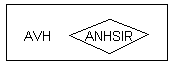
Fig. 1 AVH database pigeon hole shelf label
A blue spot indicates that some non-Australian specimens have not yet been databased.
2.3.2 Order within Asteraceae, Fabaceae, Myrtaceae and Poaceae
- Asteraceae and Fabaceae have been further arranged into Tribes Myrtaceae into Informal Groups, and Poaceae into Subfamilies.
- Within these various subdivisions genera run alphabetically and likewise with species within each genus (with the exception of Eucalyptus (Myrtaceae), see below).
- Each Tribe/Group/Subfamily is marked by a shelf label on the pigeon hole in which it begins. In Myrtaceae the start of each group is indicated by a colour coded shelf label that refers to a legend on the outside of the compactus of the family.
- There are alphabetical lists of genera and corresponding Tribe/Group/Subfamily lists for each of these families hanging on the outside of the compactus near that family to enable easy lookup and location of genera within the family.
- Eucalyptus species are arranged phylogenetically rather than alphabetically. An alphabetical list of species and their corresponding bay and column number is available on the outside of the compactus. To help locate taxa of Eucalyptus, just remember that when facing each bay, as the columns run left to right, as does the column numbering system. The order of the states is also different running clockwise starting with NT followed by Qld, NSW, ACT, VIC, TAS, SA and WA.
2.3.3 Taxon folders
- Specimens of the same taxon are grouped together in a single taxon folder or several taxon folders depending on the number of specimens. As the collection is made up of specimens from the CSIRO Plant Industry herbarium (large sheets) and the ANBG (formerly CBG) herbarium (small sheets) there are different sized taxon folders. The smaller ANBG folders sit above the larger CSIRO folders of the same taxon to allow retrievability of all like specimens while maintaining a stable pile in the pigeon hole.
- Specimens from Australia are placed in brown or buff taxon folders and those from outside Australia are placed in blue taxon folders. A previous way of indicating non-Australian specimens was to use the brown taxon folders opening left-to-right (backwards) or adding a purple stripe stamp to the right-to-left opening brown folders. Both these type of folders are gradually being replaced with blue folders.
- Many of the taxon folders have a boxed spine for easier containment of many specimens of the same taxon/geographic area. See Figure 2. This also adds stability to the pile in the pigeon hole. This is encouraged wherever possible.
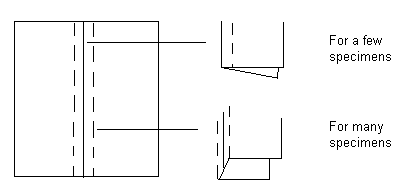
Fig. 2 Folding a taxon folder
2.3.4 Folder annotation
Taxon folders are annotated along the lower edge to maintain the order on the shelves and assist with retrievability of the specimens needed without having to open every folder.
- The bottom lower edge of the taxon folder is annotated with the family name, taxon name and author, and the state or country of collection. The diamond shaped "ANHSIR" or rectangular shaped "IBIS" stamps indicate the taxon is databased in the herbarium database ANHSIR (Australian National Herbarium Specimen Information Register). As the collection is an amalgamation of folders of specimens from CSIRO and ANBG, the information on the folders is written in a slightly different order. Figure 3 below illustrates how the folders are to be annotated from now on.
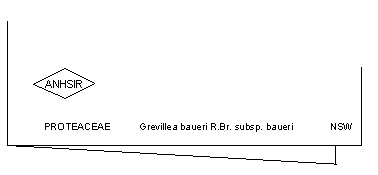
Fig. 3 Position of annotations on taxon folder
- For cultivated specimens ‘CULT.’ replaces the state or country of collection in the bottom right hand corner.
- An ‘*’ before a taxon name indicates this taxon is introduced or naturalised. This occurs mainly on ANBG folders and has been discontinued.
2.3.5 Typical order of taxa within a family
Within a family genera run in alphabetical order and within each genus species run in alphabetical order. The exceptions are families in section 2.3.2 that are divided into subfamily, tribe or group first, then genera and species run in alphabetical order as above. For an example of a typical taxon folder order within a family see Table 1.
- Specimens with uncertain identifications, i.e. with ‘cf (compare with), ‘aff.’ (has affinities to) or ‘?’ before the species name are placed within the species that is referred to.
- Often a species is further subdivided into infraspecific taxa such as subsp. (subspecies), var. (variety) or f. (form), these divisions are placed in this order and then alphabetically above the species they relate to.
- Intergrades sometimes occur between species, and these are placed after the specific taxon that is the first parent.
- Intergrades sometimes occur between subspecies, varieties and forms of a species and these are placed after the infraspecific taxon that is the first parent.
- Specimens with uncertain identifications, i.e. with ‘cf (compare with), ‘aff.’ (has affinities to) or ‘?’ before the species name are placed within the species that is referred to.
- The division ‘form taxon’ relating only to the genus Senna, Caesalpiniaceae, is not used in the Australian National Herbarium. Please refer to the Curation Table at http://www.anbg.gov.au/cgi-bin/curation for more details.
- Taxa with Manuscript names are filed alphabetically by species (i.e. treated the same way as current published names)
- Named hybrids, e.g. Pimelea X tetracarpa are placed within the normal alphabetical order of species within the genus.
- Hybrids that do not have a published name as above e.g. Pimelea ammocharis X imbricata are placed at the end of the genus that is the first parent and then alphabetically by the first species. Usually if known, the name of the male parent is first followed by the name of the female parent.
- Hybrids of uncertain parentage, e.g. Pimelea hybrid are placed below hybrids of known parentage.
- Cultivars of known origin e.g. Pimelea saxicola ‘Paynes Hybrid’ are placed alphabetically above the species they relate to but below any subspecies, varieties or forms.
- Cultivars of unknown origin e.g. Pimelea cv ‘Ruby’ are placed below all the hybrids.
- Specimens that are only identified to genus or determined as potential new taxa (e.g. ‘sp. nov.’) are placed at the very end of the genus.
- Likewise specimens that are only identified to family, tribe or group are placed at the end of the family, tribe or group.
- In some families, after the family unidentified material, there may be small mounted sheets of various genera (the remainder of the old CSIRO Plant Industry collections). The small mounted sheets for these families are slowly over time being mounted and incorporated into the collection through loan requests, curation and databasing. Please do not incorporate this material into the collection until it has been remounted.
| Family – Thymelaeaceae | ||
Pimelea |
ciliata (also includes cf., aff. or ?ciliata) |
|
Pimelea |
flava |
subsp. dichotoma |
Pimelea |
flava |
subsp. flava |
Pimelea |
flava (subsp. status not known) |
|
Pimelea |
harveyi |
|
Pimelea |
harveyi intergrade P. flava |
|
Pimelea |
imbricata |
var. imbricata f. gracillima |
Pimelea |
imbricata |
var. imbricata f. imbricata |
Pimelea |
imbricata |
var. imbricata intergrade var. major |
Pimelea |
imbricata |
var. major |
Pimelea |
imbricata (var. or f. status not known) |
|
Pimelea |
longifolia ms |
|
Pimelea |
X pilosa (named hybrid) |
|
Pimelea |
saxicola ‘ Paynes Hybrid’ |
|
Pimelea |
saxicola |
|
Pimelea |
villifera |
|
Pimelea |
ammocharis X imbricata |
|
Pimelea |
neoanglica X ammocharis |
|
| Pimelea | saxicola hybrid (one parent not known) | |
Pimelea |
hybrid (uncertain parentage) |
|
Pimelea |
cv ‘Ruby’ (cultivar of unknown origin) |
|
Pimelea |
sp. Burketown (J. G. West 6758) BRI Herbarium |
|
Pimelea |
sp. (not identified to species incl. sp. nov.) |
|
[No name] |
specimens only identified to family |
|
[various genera] |
small mounted sheets |
|
Table 1. A typical taxon folder order on the shelves
Each taxon is then divided into either Australian states/territories or geographical regions depending on its collection locality and placed into an appropriate coloured folder. The order within each taxon and appropriate folder colour for these divisions is outlined in Table 2 below:
Folder order within a single taxon |
Taxon folder colour |
Illustrations or notes about a taxon e.g. keys to species, distribution, descriptions, etc. |
Green folders (still some brown folders with green stripes in the collection) |
Wild specimens collected in Australia, state order west to east, except for Eucalyptus – which runs clockwise starting with NT. *Note: [ ] is the old state code used on ANBG folders |
Brown or buff |
WA [W] |
Brown or buff |
NT [D] |
Brown or buff |
SA [S] |
Brown or buff |
Qld [Q] |
Brown or buff |
NSW [N] incl. Jervis Bay (ACT) |
Brown or buff |
ACT [C] |
Brown or buff |
Vic. [V] |
Brown or buff |
Tas. [T] |
Brown or buff |
OCEANIC Is. [I] incl. Lord Howe Is (NSW); Norfolk Is., Ashmore & Cartier Reefs, Christmas Is., Cocos (Keeling) Is., Coral Sea, Macquarie Is (Tas.), Heard Is. |
Brown or buff |
CULT. [H] Specimens cultivated in Australia (see section 2.4) |
Brown or buff |
Wild specimens not collected in Australia, for detailed order see Appendix 1 |
Blue |
CULT. [H] Specimens cultivated outside Australia (see section 2.4) |
Blue |
Australian specimens identified only to genus |
Brown or buff |
Non-Australian specimens identified only to genus |
Blue |
Australian specimens identified only to family |
Brown or buff, changing to orange |
Non-Australian specimens identified only to family; often in collector and collector number order |
Blue, changing to orange |
Small mounted sheets, alphabetical by genus |
Buff |
Table 2 Folder order and colour within a single taxon
2.4 Cultivated vouchers
Cultivated vouchers are housed in different folders depending on whether there is an existing wild specimen or wild details (represented by a dummy sheet) or not.
- An original wild specimen exists in the herbarium
A cultivated voucher that has an original wild parent specimen in the collection should be put within the same flimsy as the wild specimen. It should be possible to find the wild specimen from the label details of the cultivated voucher. These wild and cultivated sheets are then kept together and put away in the taxon folder that the wild specimen was in. These cultivated vouchers DO NOT go in a taxon folder marked ‘CULT.’. In the case of either the wild specimen or the attached cultivated specimen being a type specimen, the non-type specimen should be incorporated into the main collection NOT the type collection as it does not represent the type specimen, e.g. orchids. This is the only instance where the cultivated and wild specimens would be housed separately.
- Only wild data exists in the database so a dummy sheet is made for the herbarium
In this instance a wild specimen was never collected, only seed, cuttings or transplants were taken and a record entered into the database. So a dummy sheet for the herbarium is made to represent the wild record in the database. Annotate the flimsy with the cultivated details. The dummy sheet is placed in the same flimsy as the cultivated voucher and they are kept together, but unlike above, they are put away in a taxon folder marked ‘CULT.’. In the case of a dummy wild sheet that is attached to a cultivated type specimen, the dummy sheet should be incorporated into the main collection NOT the type collection as it does not represent the type specimen, e.g. cultivated orchids. This is the only instance where the dummy wild sheet and cultivated specimen would be housed separately.
- A cultivated voucher with very little or no wild origin data
Often there are little or no wild details associated with cultivated vouchers. These specimens are treated as single cultivated vouchers and are put away in a taxon folder marked ‘CULT.’.
2.5 Empty or ‘dummy’ folders and specimens
Empty or ‘dummy’ folders and specimens can often be found in the collection. These folders are there for a reason, so please don’t throw them out just because they are empty. They provide a marker to indicate the following:
- Name changes – during curation of a group, recent taxonomies are applied to the specimens which often results in species, genus or sometimes even family name changes. To indicate the name change, an empty folder is stapled closed and annotated to indicate the current name by placing brackets around the old name and writing the current name above it, preceded by ‘=’ or ‘see’. This closed folder is filed under the old name. Users who go to this old name folder are then directed to the current name.
- Specimens are on loan – when specimens are requested on loan, most specimens of a taxon are sent as required for research. Paperwork to indicate that specimens are on loan can be found in the red folder at the beginning of the family, or sometimes there is a note attached to a cardboard near where the specimens have been removed. The resulting pigeon holes of empty folders should remain where they are as an indicator that the specimens are on loan and to reserve the space for when they are returned.
- Carpological material, spirit material or floral card without a herbarium sheet – sometimes a specimen may only be represented by separate fruit, spirit material or a floral card. To alert users of the collection to these specimens a ‘dummy’ herbarium specimen containing a blank sheet with the CANB number and label details is added to the collection.
- Wild collection database record when only a cultivated voucher exists – sometimes only seed, cuttings or whole plants are collected for further propagation and no wild specimen is made. The wild collection details are recorded in the database only so a dummy sheet is made and put with the cultivated voucher to represent the wild information.Sometimes a dummy wild sheet represents the wild collection details of a cultivated type specimen. In this case the dummy sheet remains in the collection while the cultivated type specimen is housed in the Type Room, e.g. cultivated orchids. This is the only instance where the dummy wild sheet and cultivated specimen would be housed separately.
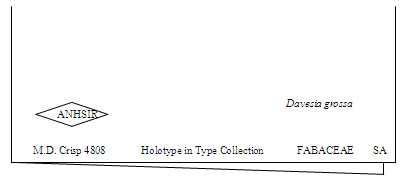
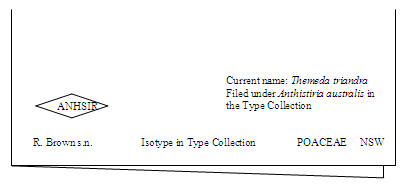
- Type specimens – within a taxon folder there may be a red and white type ‘dummy’ folder which contains an empty mounting sheet. The original type specimens are kept separate from the main collection in the Type Room (see section 2.7). The type ‘dummy’ folder is filed in the collection under the current name, while the type specimen is filed in the Type Room under the type name. The type ‘dummy’ folder is annotated with collector details, kind of type and the current name (see Fig. 4). When the current name and the type name are not the same, then annotate the type ‘dummy’ folder as illustrated in Fig. 5.
Fig. 4 Annotations on a dummy type folder
Fig. 5 Annotations on a dummy type folder when the type name is not the same as the current name
2.6 Carpological Material
Carpological material for each family is stored in herbarium specimen boxes on the top compactus shelf above where the relevant family begins. The front of the box is labelled with the family name and ‘FRUIT SEPARATE’. Some of the carpological collection is well curated and each specimen has a copy of the specimen label included in the bag with it. Carpological material for these taxa may be sorted into genera and this will be marked on the box. However, for the rest of the carpological collection the only details with the specimen will be the collector, collector number, name and sometimes a brief locality. Also several boxes may contain a mixture of genera. As families are curated their associated carpological material will be curated as well. The labels of herbarium specimens that have ‘Fruit Separate’ should be annotated as such.
2.7 Type Collection
The original type specimens are placed in red and white folders and are housed separately from the main collection. With the exception of Eucalyptus and Orchidaceae, the Dicot and Monocot types are housed on the CSIRO site in the Type Room, Bldg 502 Level 1 south side. Eucalyptus types are housed in Bldg 502A, level 1, north side, at the end of Myrtaceae in compactus Bay 137. The Orchidaceae types can be found in Bldg 502A, Level 2, south side, at the beginning of Orchidaceae, in compactus Bay 3. The Fern and Gymnosperm type specimens are housed on the ANBG site in boxes in the middle fixed bay of the south side of the herbarium compactus.
The families are arranged alphabetically within each major group e.g. Monocots and Dicots, and not phylogenetically as in the main collection. The type specimens are arranged alphabetically by genus and species within a family under their type name, not current name as in the main collection.
The categories of types housed in the Type Collection are:
Holotype
Isotype
Syntype
Isosyntype
Neotype
Isoneotype
Lectotype
Isolectotype
Epitype
Isoepitype
Each of these type specimens, when fully curated, will have a copy of the relevant protologue, where the type is cited for a taxon, included with it. All type specimens are databased or will be in due course, and this is indicated by the ‘ANHSIR’ or ‘IBIS’ stamps on the sheet and the outside flimsy.
Cultivated types should be housed in the Type Room but any associated dummy sheets of wild collecting data, i.e. a wild voucher was never collected but the wild information exists as a database record, should be housed in the main collection as they are not part of the cultivated type specimen.
Some Type specimens do not have type status at CANB, so should not be housed in the Type Room. They should be incorporated into the main collection under the relevant taxon, with the type information retained on the sheet and in the database. Type specimens that should not be housed in the Type Room include:
- Photographs and photocopies of any sort of type, these should be mounted up as a herbarium sheet and put in the main collection under the current name. If the photo is one of the above types and is accompanied by an herbarium specimen of the same collection, e.g. the CANB specimen is the holotype and the photo is of the BRI isotype, then the photo should be mounted as a herbarium sheet and placed in the holotype specimen’s dummy type folder in the collection, with the dummy folder annotated accordingly.
- Specimens nominated as paratypes, topotypes or clonotypes.
2.8 Spirit Collection
All the spirit material relevant to the herbarium collection is stored on compactus units in the purpose built Spirit Room, Bldg 502A, Level 2, north side at the western end. The bottles sit in perspex trays on the shelves. The order starts at the top left hand pigeon hole and runs down and up the columns the same as in the herbarium specimen collection. The solution that the specimens are preserved in is mostly either 70% ethanol or Bangmix which is 70% ethanol, 20% water and 10% glycerol. A small proportion of the older CSIRO bottles contain FAA (formaldehyde, ethanol and acetic acid). This liquid is toxic and corrosive, requires careful handling and in an area with adequate ventilation, e.g. a fume hood.
There are three separate collections housed in this room, each in its own order.
- Orchidaceae spirit material – is very well curated. The trays are ordered alphabetically by genus, with trays containing small bottles first and then the order starts again with the larger sized bottles. This collection occupies Bays 1-4 of the compactus.
- Eucalyptus spirit material – is very well curated. The trays are ordered alphabetically by species, and this collection occupies Bays 5-6 of the compactus.
- General spirit collection – requires a lot of attention. The trays are ordered phylogenetically to follow the old Bentham & Hooker system (an alphabetical family list is located on the top shelf of Bay 6 for finding family numbers). This collection occupies Bays 6-9 of the compactus. The shelved bottles are all CSIRO material. The CBG general spirit material is in wooden boxes on the static metal shelving next to the door and is in CBG accession number order.
**NOTE: Please be careful moving trays of bottles as they can be quite heavy.
2.9. Frequently Asked Questions
Q.1. What do the different coloured folders represent?
A. Brown or buff taxon folders house specimens from Australia and it’s External Territories. Blue folders are for specimens from outside Australia. Green folders house illustrations or notes about a taxon. Orange folders house specimens that are only identified to family. See Table 2 in section 2.3.5 for more details.
Q.2. Why are there empty taxon folders, red and white striped folders or blank ‘specimens’ on the shelves?
A. These folders are ‘dummy’ folders to indicate either 1. name changes in the collection, 2. specimens that are on loan, 3. type specimens or 4. specimens that are only represented by carpological or spirit material or a floral card. See section 2.5 for more detail.
Q.3. What do the brown folders that open left to right or the purple striped folders mean?
A. These folders represent the old system of indicating non-Australian specimens. They are gradually being replaced by blue folders. See section 2.3.2.
Q.4. Why are there 2 different sized taxon folders housing 2 different sized herbarium specimens?
A. The collection is an amalgamation of the CSIRO Plant Industry herbarium (large sheets) and the ANBG (formerly CBG) herbarium (small sheets). The two collections are now one and the collection is known as CANB. CSIRO and ANBG taxon folders of specimens of the same taxon/state are interleaved, small one above, larger one below, to allow easier retrievability of all like specimens while maintaining a stable pile in the pigeon hole.
Q.5. What is the material in newspaper/small sheets at the end of the genus/family?
A. The specimens in newspaper are unprocessed backlog that needs to be mounted before incorporation into the collection. The small sheets are the remainder of the CSIRO Land Research herbarium and also need to be remounted before they can be incorporated. Please don’t incorporate any of this material into the collection but leave it where it is and don’t add newly mounted specimens to these folders.
Q.6. Do all type specimens go into the Type Room?
A. No, only specimens in the following categories: holotype, isotype, syntype, isosyntype, lectotype, isolectotype, neotype, isoneotype should be incorporated into the Type Room. All other sorts of type e.g. paratype, topotype or clonotype and photographs of types should be incorporated into the main collection under their current name. See section 2.6.
Q.7. How does one find a spirit specimen in the Spirit Collection?
A. If the collection is a taxon other than Eucalyptus or Orchidaceae and has a CANB number, check the list on the top shelf of Bay 6 in the Spirit Room for the family number, then check the shelves. For more details see section 2.7.
3. THE NON-VASCULAR COLLECTIONS
The Mosses, Lichens, Liverworts, Hornworts, Fungi and Algae are housed on the ANBG site.
3.1. General arrangement and references
3.1.1 Fungi (CF)
By class and some orders then alphabetical by genus. Genera are stored in alphabetic order within major groups (Agaricales, Aphyllophorales, ascomycetes, gasteromycetes and miscellaneous microfungi).
3.1.2 Lichenised Fungi (CL)
Alphabetical by genus.
Checklist of the Lichens of Australia and its Island Territories:
http://www.anbg.gov.au/abrs/lichenlist/introduction.html
3.1.3 Myxomycetes - Slime Moulds (CX)
Alphabetical by genus.
3.1.4 Bryophytes - Mosses (CM)
Alphabetical by genus.
Morphology, anatomy and, classification of the Bryophyta in Bryophyte Biology, ed. B. Goffinet & A. J. Shaw, 2nd edition Cambridge Uni Press 2009.
3.1.5 Bryophytes - Hornworts (CC)
Alphabetical by order and then by genus within each order.
National Species Listhttps://biodiversity.org.au/nsl/services/apni
and
New insights into morphology, anatomy, and systematics of hornworts in Bryophyte Biology, ed. B. Goffinet & A. J. Shaw, 2nd edition Cambridge Uni Press 2009.
3.1.6 Bryophytes – Liverworts (CH)
Alphabetical by genus.
National Species List
https://biodiversity.org.au/nsl/services/apni
and
Morphology and classification of the Marchantiophyta in Bryophyte Biology, ed. B. Goffinet & A. J. Shaw, 2nd edition Cambridge Uni.
3.1.7 Algae (CA)
Alphabetical by genus
AlgaeBase: http://www.algaebase.org/
3.2 Location & order in compactus
3.2.1 Fungi, Lichens and Slime Moulds
- Specimens are packaged in packets or specimen-boxes and stored in collection-boxes on shelves in the compactus unit. The groups contained are noted on the side of each compactus unit. Fungi are in compactus unit openings 2, 3 & 4 and the Slime moulds and miscellaneous microfungi are in the stationary unit (opening 7) of the mixed-collection side of compactus. Lichens occupy most of the north side of the compactus.
- Within each compactus unit, columns are filled from left to right and boxes are arranged shelf by shelf from top to bottom of each column.
- Each box is labelled with the first taxon within it.
- Within each group (e.g. Fungi), genera are in alphabetical order and within each genus species are in alphabetical order. Specimens named only to family are stored following the specimens identified to at least genus. Oversized specimens are at the end of the group, before family-determination only specimens and indeterminate specimens are stored by growth type (e.g. foliose, crustose, etc.). A cross-reference card indicating the existence of an oversize specimen is placed at the appropriate point in the main part of the collection (i.e. with the standard size packets/boxes).
- All Australian, Australasian and Antarctic specimens have been completely databased. Subantarctic specimens are partially databased. Sundry other specimens have been databased for various projects but not on a consistent basis.
3.2.2 Algae
Algae are either: (a) mounted flat on standard herbarium sheets or (b) enclosed in packets or boxes. The sheets of mounted algae are stored in taxon folders in the same manner used in the vascular plant collection, with taxon folders ordered alphabetically by genus. The boxed or packeted algae are stored in small storage boxes at the end of each shelf. The storage boxes are ordered alphabetically by genus and may contain specimens from one to several genera. The algae are stored in the compactus at the end.
3.2.3 Mosses, liverworts and hornworts
Specimens are stored in packets or boxes and placed in filing cabinets with shallow drawers. The front of each drawer is labelled, indicating the genera and/or species enclosed or in the case of large collections of particularly common species, in which state or territory the specimens were collected.
Oversized liverwort specimens are housed in separate drawers at the end of all liverwort genera. These are followed by liverwort specimens determined to family only, indeterminate thalloid liverworts and indeterminate leafy liverworts respectively.
Oversized moss specimens are housed in separate cabinets at the end of all moss genera. These are followed by moss specimens determined to family only, indeterminate acrocarpous moss specimens, indeterminate pleurocarpous moss specimens, and indeterminate moss specimens. A cross-reference card indicating the existence of an oversize specimen is placed at the appropriate point in the main part of the collection (i.e. with the standard size packets/boxes).
3.3 Packaging/boxes/packets
Those specimens housed individually in archival packets or labelled small boxes are stored in an upright position in rows, either in open-topped boxes on the compactus shelving or in shallow drawers in filing cabinets.
Each open-topped box or filing cabinet drawer contains one, two and three rows of specimens, the order running from the front of the box or drawer to the back of the box or drawer, left-hand row to right-hand row.
3.4 Box/packet annotations
ANHSIR/IBIS stamp – These designate that the specimens were databased after their initial incorporation.
Packet – specimens stored in printed packets were databased before incorporation, with details printed directly from the ANHSIR database. All label information is printed on the front of the packet, except the CANB/CBG accession number which is printed on the back. Specimens originally received as exchange from other institutions may have the labels supplied by the donor institution stored inside the packets
Box – specimens stored in boxes with printed labels were databased before incorporation, with details printed directly from the ANHSIR database, Summary information (i.e. taxon name, accession number barcode, collector's initials, collector's number, state are shown on one long side of the box, which sits uppermost). All label information (except herbarium accession number) is then repeated on a label placed on the front lid of the box.
Determinavit slips and any notes or original labels are placed in polypropylene bags inside packets or beneath the specimen in boxed specimens. If the specimen is mounted on card the card is annotated "notes under card". In all cases names are updated on the front of the packet in pencil.
3.5 Typical order of taxa within a group/family
Taxon order:
- Genus species subspecies
- Genus species
- Genus
- Group indet.
- Order
- Family
Geographic order: alphabetical by state or territory on the Australian mainland, then alphabetical by Australia's external territories, then overseas.
Australian (white packets or boxes with white labels):
- ACT
- JBT
- NSW
- NT
- QLD
- SA
- TAS
- VIC
- WA
- Australian Antarctic Territory
- Christmas Island
- Cocos (Keeling) Islands
- Heard Island
- Lord Howe Island
- Macquarie Island
- Norfolk Island
Overseas: in alphabetical order by country on label (blue packets or boxes with blue labels)
Note: due to historical change within the institution, some specimens collected from Australian external territories may have blue labels instead of white.
3.6 Cultivated vouchers
These will be placed immediately behind the original wild collection in a separate green packet.
3.7 Cross-reference cards
- Name changes – white cross-reference cards are placed in the collection to indicate when a taxon is now considered a synonym.
- Specimens on loan – on-loan white cards are placed at the appropriate point in the collection when specimens are sent on loan for research purposes. Paperwork with the details of the loan can be found in the trays near each group (on cabinets for bryophytes; on benches for fungi, lichens and slime moulds; on first compactus shelf for algae). The resulting empty spaces in boxes or drawers should not be filled, as they serve to indicate that the specimens are on loan and to reserve the space for when the loan is returned.
- Spirit material or oversized material – sometimes a specimen may be represented by spirit material alone or be too large to go in the main collection. To alert users of the collection to these specimens a white cross-reference card with the CANB number and label details is added to the collection.
- Type specimens –The type specimens are kept in the Type cabinets, separated from the main collection. A pink type cross-reference card is filed in the main collection under the current name, while the type specimen is filed in the Type cabinets under the original name for which the material is a type. The type cross-reference card is a complete copy of the type specimen label, sometimes with additional annotations indicating the basionym and any other name changes. If a taxon has had many name changes there will be multiple cross-reference cards in the collection to refer the user to the type material.
- Mixed collections – The taxon comprising the majority of the specimen is listed as the taxon name on the specimen and the material is filed under that name in the collection. White cross-reference cards are created for each additional taxon and these are stored under the secondary taxon names at the appropriate points in the collection.
3.8 Oversized material
Larger specimens of all groups are located separately from the main collection usually at the end of each group. For example, mosses, liverworts and hornworts are stored in 'long packets' and larger square packets and located in a separate drawer cabinet, arranged in alphabetical order by genus. See Section 3.2 for the location of oversized material for each group. Cross-reference cards are placed in the main collection to indicate their location.
3.9 Type collection
All non-vascular cryptogam types are housed in specially-marked filing drawer cabinets, separate from the main group collections except for the algae and the slime moulds. The algae and slime moulds are stored with the vascular cryptogam (fern and gymnosperm) types in the stationary bay of the compactus unit, (opening 7?). Only the type categories of holotype, isotype, syntype, isosyntype, lectotype, isolectotype, neotype, isoneotype are stored as types. All other sorts of type, e.g. paratype, topotype or clonotype and photographs of types are stored in the main collection under their current name.
3.10 Spirit
The algae, fungi and bryophyte spirit collections are housed in the Spirit Room of the Australian National Herbarium buildings on the CSIRO site. These are currently being assessed and will either be converted to dried specimens for storage in the main cryptogam collections or discarded if unsuitable.
3.11 Frequently asked questions
Q.1. What do the different coloured packet and label colours indicate?
A. Specimens in white packets or boxes with white labels are from Australia and Australian external territories; specimens in blue packets or boxes with blue labels are from outside Australia. See section 3.5.
Q.2. What do the different coloured cards in amongst the specimen packets/boxes indicate?
Q.3. Where are oversized specimens stored?A. White cards are cross-reference cards that can indicate: 1. a name change, 2. specimens are on loan, 3. an oversized specimen or spirit material only that is located elsewhere, or 4. a mixed collection where several taxa are part of the same collection. Pink cards represent type specimens that are located separately. See section 3.7 for more detail.
Q.4. Are all type specimens stored in the one place?A. Usually at the end of each group. See section 3.2 for more detail.
A. No, see section 3.9 for more details.
APPENDICES
Appendix 1 Political and geographic regions used to group specimens within a taxon.
Geographic area |
Countries, States or Islands ([W] is the old state code used on ANBG folders) |
Territories, Countries or Islands included. |
Use a separate taxon folder for specimens from each of the regions below (or if only a few specimens put together in one folder marked with geographic area). |
||
Australia |
W.A. [W] |
|
N.T. [D] |
||
S.A. [S] |
||
QLD [Q] |
||
N.S.W. [N] |
Jervis Bay (ACT) |
|
A.C.T. [C] |
||
VIC [V] |
||
TAS [T] |
||
OCEANIC Is. [I] |
Lord Howe Is (NSW) |
|
Norfolk Is. |
||
Ashmore and Cartier Reefs |
||
Christmas Is. |
||
Cocos (Keeling) Is. |
||
Coral Sea |
||
Macquarie Is. (TAS) |
||
Heard Is. |
||
Pacific Islands |
New Zealand |
|
New Caledonia |
||
Other Islands |
Fiji, Vanuatu, Hawaii etc. |
|
*Papuasia |
East New Guinea |
Papua New Guinea |
|
West New Guinea |
Irian Jaya/West Papua |
Bismarck Archipelago |
||
Solomon Is. |
||
Malesia |
Lesser Sunda Is. |
|
Moluccas |
||
Sulawesi |
||
Java |
||
Sumatra |
||
Malaya |
||
Borneo |
||
Philippines |
||
S & SE Asia |
Thailand |
|
Indochina |
Vietnam, Laos, Cambodia |
|
Burma |
||
India |
Sri Lanka, Bhutan, Nepal, Pakistan, Maldive Is. etc. |
|
Eurasia |
China |
Hainan, Taiwan |
Korea |
||
Japan |
||
Russian Federation |
||
SW Asia |
Afghanistan to Yemen to Turkey |
|
Europe |
UK to Scandinavia to Ukraine |
|
Africa |
Africa |
|
America |
North America |
Canada, Greenland, USA |
Central America |
Mexico to Panama |
|
South America |