

Council of Heads of Australasian Herbaria
Australian National Herbarium
Biographical Notes

|
|
Council of Heads of Australasian Herbaria | |
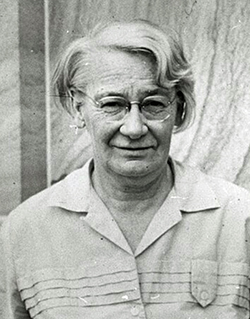 Hill, Dorothy (1907 - 1997)
Born in Taringa, Queensland on 10 September 1907; died on 23 April
1997 in Brisbane, Qld.
She was born in Taringa, the third of
7 children, and grew up in Coorparoo in
Brisbane. She attended Coorparoo State
School and then won a scholarship to
attend Brisbane Girls Grammar School.
Following high school, she considered
studying medicine and pursuing studies in
medical research; however, at the time, the
University of Queensland did not offer a
medical degree, and the Hill family could not
afford to send Dorothy to Sydney.
Fortunately, she won one of twenty entrance
scholarships to the University of Queensland
in 1924,
where she decided to study science, in
particular chemistry. She chose to study
geology as an elective, and she graduated in 1928 with a First Class
Honours degree in Geology and the university's Gold Medal for Outstanding Merit.
She continued to work as a UQ Fellow through 1929-30 on scholarship while she was studying
her Master of Science, conducting research in the Brisbane Valley on the stratigraphy of
shales in Esk and sediments in the Ipswich basin.
She began to collect fossils after she
was introduced to them in the local limestone of a farm, where she was holidaying in
Mundubbera.
She won a Q Foundation Travelling Scholarship to study at the University of Cambridge's Sedgwick Museum, in
residence at Newnham College, just as the Great Depression was taking effect.
She worked
on her PhD under supervisor, Gertrude Elles. (Australian universities did not begin
awarding PhDs until 1948!)
She continued
to explore the theory that Australia had once been covered from north to south by an
inland sea, as evidenced by the fossil corals she found in Mundubbera. She received a
further scholarship for two years and the Daniel
Pidgeon Fund award from the Geological Society of London which enabled her to remain
in England until 1936.
After Hill's return to
Australia, she continued to study at the University of Queensland and took a Doctor of
Science in 1942.
From 1937 to 1942, Hill was the recipient of a Council for Scientific and Industrial Research (CSIR) grant and worked as a research fellow at the University of Queensland.
During World War II, Hill enlisted in the Women's Royal Australian Naval Service, where she worked 80-90 hours a week in between her coral research and the cipher and coding of shipping orders in General Douglas MacArthur's division.
From 1946 to 1955, Hill served as the third secretary of the Great Barrier Reef Committee. She was instrumental in getting facilities at the Heron Island Research Station constructed.
In 1947, Hill was president of the Royal Society of Queensland. In 1952, she was chairman of the Geological Society of Australia, Queensland Division. In 1956 Hill became the first female fellow of the Australian Academy of Science.
In 1971, Hill became president of the Professorial Board of the University of Queensland, the first woman to be so recognised.
She was recognised with an Honorary Doctor of Laws from the university in 1974, in acknowledgement of her time on the Professorial Board.
For about fifteen years after she retired she came daily to the University to work. However she had a fall which caused her to be hospitalized. After a long period of recovery she had an occasional loss of memory and ceased to come into the department. Subsequently her health declined further, and she suffered a final stroke on 23 April
1997.
Source: Extracted from:
https://en.wikipedia.org/wiki/Dorothy_Hill
Historical Records of Australian Science, Vol.12, No.2, 1998
https://science.org.au/our-focus/history-australian-science/fellows-biographical-memoirs/dorothy-hill-1907-1997
Portrait Photo: Historical Records of Australian Science, Vol.12, No.2, 1998.