






Staff and Visitor Handbook
A summary of information, facilities and services of the Centre and the Herbarium for staff,
particularly new staff, and for visitors.
December 2005
Table of Contents
1. Contact details
2. Management
3. Visitors to the ANH
4. Herbarium Services
5. Permits to Collect
6. Libraries
7. The Map Room
8. Research Support
(i) Information Technology
(ii) Laboratories, Facilities and Equipment
9. Centre Resources
10. Centre Vehicles
11. Field Trips
12. General Information
Telephones
Stores
Purchase Requisitions
Forms
Tea Club
Staff Meetings
Parking and Parking Permits
Canteen - Kiosk - CafeAppendix I CPBR / ANH telephone listing
Appendix II Map of CSIRO Black Mountain Laboratories
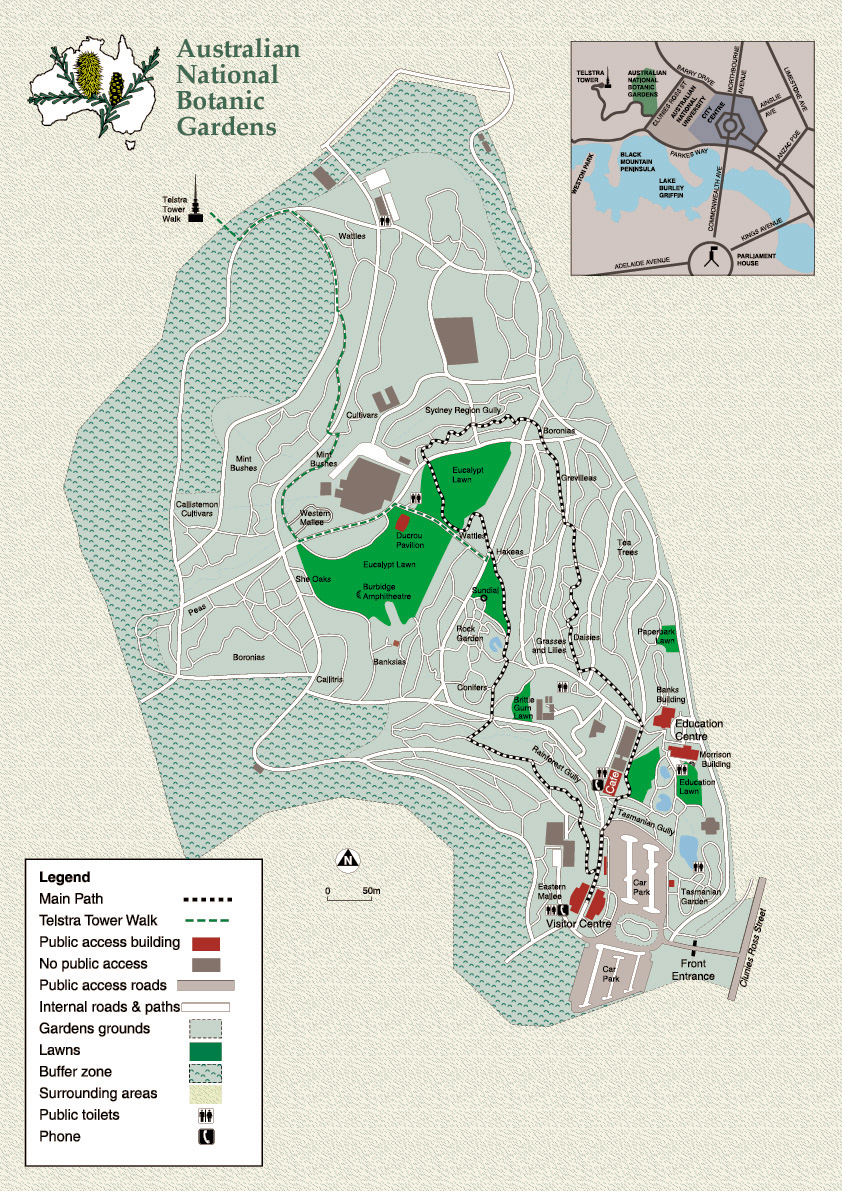
Appendix III Map of Australian National Botanic Gardens
Appendix IV Emergency Procedures (incl First Aid Officers for Herbarium/ANBG)
Appendix V ANBG Fire Wardens
Appendix VI Emergency Services
Centre for Plant Biodiversity ResearchThe Centre for Australian National Biodiversity Research (CANBR) is a collaboration between the Commonwealth Scientific and Industrial Research Organisation’s (CSIRO) Division of Plant Industry (PI) and Department of Sustainability, Environment, Water, Population and Communities (SEWPaC) through the Australian National Botanic Gardens (ANBG). The Australian National Herbarium (ANH) is the focal core of the Centre and is one of the three largest plant collections in Australia. It is unique among the Australian Herbaria in having a national focus for its collections, acquisition and research programs. The main herbarium collections are housed on two sites in Canberra – on CSIRO PI site and at the ANBG, with a specialised rainforest collection at Cairns, north Queensland. |
1. Contact Details
Director
Dr Andrew Young
Centre for Australian National Biodiversity Research
Tel: +61-2-6246 5113
Fax: +61-2-6246 5249
Email: andrew.young@csiro.au
Postal Address |
Street Address |
Contact Details
Tel: +61-2-6246 5084
Fax: +61-2-6246 5249
Web: http://www.cpbr.gov.au/cpbr/
2. Management
Director
The Centre is administered by the Director, Dr Andrew Young in conjunction with Mr Jim Croft as senior managers of the CSIRO and ANBG staff respectively.
Andrew Young 6246 5113, Room 3.19, Level 3, ANH – CSIRO site, email: andrew.young@csiro.au
Personal Assistant: Cath Reed, 6246 4865, email: cath.reed@csiro.au
Centre Office
The Executive Assistant, Cath Reed, provides administrative support to the Centre, the Director and Senior Managers. Any administrative enquiries should be directed to Cath. The Centre Office is located on Level 3, Room 3.20.
Cath Reed: 6246 5084, Room 3.20 Level 3, ANH – CSIRO site, email: cath.reed@csiro.au
Centre Fax: 6246 5249
Access and Security
Both the CSIRO PI and ANBG research facilities are open Monday to Friday, except public holidays. Working hours are 8.30 am to 5.00 pm. Note that the ANBG gates are locked at 5:00 pm sharp. Closing time is usually extended in the summer months.
Access to the Centre and Australian National Herbarium on the CSIRO site is via the main door entrance on Level 2. Wheelchair access is via the ramp to this entrance. An internal lift provides access to all floors. Free car parking at ANH CSIRO site is available in front of and behind the building
On arrival, visitors should phone the staff member they have come to visit or phone Cath Reed on 6246 5084 for access. On entry, visitors are required to sign the Visitor's Book at Reception. Visitors requiring access to the Centre at times other than working hours need approval to gain a security pass – contact Cath Reed 6246 5084 to check procedure. Security matters should be addressed through the Building Manager, Andrew Slee 6246 5514, during working hours or the Security Guard, Guard House 6246 5651 out of hours.
Access to the ANH herbarium on the ANBG site is via the Botany building. Wheelchair access is available by prior arrangement.
Staff and visitors wishing to work on the ANBG site may obtain parking permits from the Centre Office to use in ANBG public parking areas from the Centre Reception.
3. Visitors to the Australian National Herbarium
Visitors wishing to use the Herbarium collection should make prior arrangements through the Curator, Brendan Lepschi, 6246 5167 or the Collections Manager, Jo Palmer, 6246 5523, or with the staff member responsible for the families of interest if this information is known beforehand.
The Dicotyledon and Monocotyledon plant families are located on three floors of the Herbarium on the CSIRO site, and the Pteridophytes and Gymnosperms are housed with the Cryptogams in the Herbarium on the ANBG site - contact Christine Cargill, 6250 9464. Visitors to either site should sign the Visitor Books provided.
Visitors are required to observe the following:
- Please take care when handling herbarium specimens, they should not be tipped upside down or bent in any way, as the plant material is very fragile. Also never put heavy objects e.g. books, on top of specimens. If moving specimens from one area to another please do so with a thick cardboard support underneath.
- New determinations or confirmations should be written on the determination or confirmation slips provided or visitor’s own supply, in permanent ink, not ballpoint or felt pens. These should then be attached with herbarium glue (not a glue stick) as near to the specimen label as practicable but without obscuring it or other labels. Please use the curation kit on the bench.
- Permission should be sought before dissecting any part of a specimen. Place the dissected pieces or loose fragments in an archival polypropylene bag and place back inside the flimsy, attaching to the mounted sheet with a plastic paper clip.
- All specimens that have had name changes or pieces dissected should be left in a pile on the bench for updating in the computer databases and on the specimen folders. Please leave a note on specimens to indicate what needs to be done and notify the curator or relevant staff member of their presence.
- Please return specimens that are no longer required and do not have name changes to their original pigeonhole in the tidy, alphabetical order of taxa in which they were originally.
- If fragments of specimens are required for future analysis, prior arrangement must be made with the Curator. Separate conditions govern the removal and use of fragment material - please ask for these if needed. Please notify curator or relevant staff member and annotate herbarium specimens with visitor’s name, date, institution and purpose of study on labels provided.
- When citing specimens from CANB, if just citing the institution then all sheets, whether they have a CANB or CBG sheet number, should be cited as from 'CANB'. If citing sheet numbers, then the following format should be:
- for a sheet with a CANB number, cite as eg., 'CANB 79367'
- for a sheet with a CBG number, cite as eg., 'CBG 96793 at CANB'.
- Specimens required on loan should be set aside and the curator notified. An official loan request is required from the visitor's institution.
- Visitors should also refer to the Collection Management Manual (see http:www.anbg/cpbr/herbarium/collection-guide/index.html)
4. Herbarium Services
Public Enquiry Service
The Australian National Herbarium offers a public enquiry service for people seeking assistance with wild plant identifications or other queries of a botanical nature.
All enquiries should initially be directed to the Enquiries Officer, David Mallinson on 6246 5508 or email David.Mallinson@deh.gov.au.
ANBG Visitor Services Section
The Visitor Information Centre (VIC) at the ANBG provides a public shopfront for the Centre, mainly for the Public Reference Herbarium and to service public enquiries related to plant identification.
Contact Bronwyn Crago 6250 9540.
Most exhibitions or displays prepared by Visitor Services for the Visitor Information Centre endeavour to portray some element of the Centre's activity.
Contact: Rod Atkins: Tel: 6250 9404
Public Reference Herbarium (PRH)
The Australian National Herbarium maintains a Public Reference Herbarium covering the ACT, NSW southern tablelands, and NSW south coast. Ultimately the PRH will contain flowering and fruiting material of all taxa in this geographic area. The PRH provides a means by which members of the public can identify their own collections. A microscope and botanical reference books and interactive keys are available for public use. The PRH is located adjacient to the Friends' Lounge on the Main Path, part of the 'Botanical Resources Centre' managed jointly by the Herbarium, the ANBG, and the Friends of the ANBG. It is available for use 7 days/week. We suggest new users have an introductory session with one of the 'Facilitators' who will provide them with access to the computers. – Contact the Visitor Information Centre 62509540.
ANBG Living Collections Section
The Centre interacts closely with the ANBG Living Collections Section through voucher specimens and database management, and through the provision of an identification service.
Researchers or commercial photographers wishing to utilize the ANBG Living Collections must obtain a permit: Contact Murray Fagg 62509530.
For further information please contact Curator, Living Collections, Paul Janssen 62509522, plus Herbarium Living Collections Liaison, David Mallinson 6246 5508.
Simple searches of living plants in the Gardens can be made from the web interface of the IBIS database:
www.anbg.gov.au/gardens/living/findaplant/index.html
Searches of living plants and their relationship with Herbarium voucher specimens require a password:
http://www.anbg.gov.au/cgi-bin/anbg
Contact Brendan Lepschi 6246 5167 for password access.
Herbarium Tours and Displays
Tours of the Herbarium and research laboratories are available for groups wishing to learn more about the Centre. In most cases they combine a presentation/display in the seminar-room or map-room with a tour of the building and activities.
Contact Murray Fagg (6250 9530) for all inquiries regarding tours of the Centre or Herbarium.
The Volunteer Program
Volunteers working in the Centre are associated with the herbarium and undertake tasks mainly involved with specimen handling and preparation.
Many of the Volunteers are retirees or students, each working a minimum of half a day a week. The Centre endeavours to ensure that Volunteers are provided with a comfortable, satisfactory and enjoyable place to work.
Volunteers work under the ANBG's Volunteer Program and are covered for insurance at work by COMCARE in a Declaration under the 'Commonwealth Employee's Rehabilitation and Compensation Act 1988', gazetted on 27 May 1992.
To ensure compliance with the requirements of this Declaration, Volunteers are registered with Bronwyn Collins and the registration form is signed by the Curator of the Herbarium. Volunteers sign on and off each time they work to ensure coverage by COMCARE.
For further information regarding Volunteer work in the Centre please contact Natalie Aked (6246 5133), Jo Palmer 6246 5523 or Bronwyn Collins 6246 5124.
For other volunteer activities available at the ANBG contact Sabrina Sonntag 6250 9538.
5. Permits to Collect
Staff who are involved in collecting specimens or fieldwork for the Centre or the ANH are required to have a permit to collect in areas managed by all State and Commonwealth jurisdictions. For the following State authorities, the Centre has arranged a combined CPBR permit:
1. Environment ACT
2. NSW National Parks and Wildlife Service
3. NSW State Forests
4. Victorian National Parks and Victorian Public Lands and Water
Arrangements for permits with other authorities are the responsibility of the individual collectors. It is usual to allow at least one month for processing of a Permit.
Staff members who require permits should contact Cath Reed and ask to be put on the distribution list. A permit pack will be distributed when approval from the appropriate State agencies has been granted and a licence/permit issued. All specimen information is entered on ANHSIR database and downloaded for submission to the relevant authorities when new yearly permits are requested.
Researchers or commercial photographers wishing to utilize the ANBG Living Collections must obtain a permit. Contact Murray Fagg 6250 9530.
6. Libraries
The Centre has access to the resources of one of the best biological scientific libraries in Australia, at the CSIRO Black Mountain site. Most of the plant systematic material from this collection is housed at the Australian National Herbarium. The staff of the CSIRO Library provide cataloguing and other library services such as bibliographic searches and inter-library loans.
Centre staff also have access to the ANBG Library collection and services. It contains specialist collections relevant to the Centre on orchids and bryophytes and the horticulture of Australian Plants. Staff of the ANBG Library also assist with bibliographic searches and loans.
On-line catalogues of these and other libraries, are available through terminals in the Centre.
Prospective users of the CSIRO libraries should read the information posted on the Black Mountain Library’s website at www.bml.csiro.au
The Australian National Herbarium Library
The Library at the ANH CSIRO site operates as a section of the CSIRO Black Mountain Library (BML).
Centre staff can obtain assistance from BML for inter-library loans/photocopying, on-line searches, and CD-ROM searches on the CDs held in BML. Inter-library loans may also be requested on-line by staff. The Herbarium Library also contains a collection of important botanical works and early herbaria in microfiche form.
Circulating journals, new journals to be housed at the Herbarium and new books are kept on display for two (2) weeks in the bay window area of the library. These are not to be taken from the library but may be borrowed once incorporated. The changeover day for the Herbarium and Black Mountain Library is Tuesday.
Black Mountain library also has new books and journals on display which may be relevant to staff.
CPBR and CSIRO staff may borrow directly from the Library. Other persons must make application through their institution's librarian who will make their request through Black Mountain Library.
* Reference items must be used in the Library or Map rooms; they cannot be borrowed. |
Library Borrowing Procedures*
1. Loans: Complete a borrowing card, giving all requested information, and place card in wire basket. CPBR staff are exempt from filling out a card, but must adhere to the following procedures:
a. For volumes:
remove card from pocket on end leaf or inner end cover, add your name and the date to the card, put the card in the pocket of one of the place-marking boards (supplies of these are located on the benches), and file the board in the shelf position of the volume being borrowed.b. For unbound journal issues, pamphlets, etc.
(which mainly lack end-pocket cards):
please use one of the small pink cards (located near the blue borrowing cards) to record both details of the item being borrowed and your name and the date, place the pink card in a board pocket and file in place of the item as for volumes.2. Returns: CPBR staff should return borrowed items to the shelf, replacing the book card in the pocket at the end of the volume and returning the board to the bench. All other borrowers should place the returned item(s) in the wire basket.
Locating Items in the Library
To determine if a sought item is held in the herbarium library, one of several courses of action can be followed:
- If the item is a serial/periodical, the shortest course is to consult the List of Serials located in the reprint box on top of the card catalogue. (Certain works, such as many floras, may be published in parts issued irregularly but are catalogued as monographs, nonetheless.) An "X" prefixing the call number indicates if the item is located in one of the sectional libraries on the Black Mountain site, and the location is identified (in our case by the self explanatory "HERB").
- The card catalogue provides for access by Title, Author/Editor, and Subject. This is the easiest way to determine the call number for those items that you know are held here, but that you are uncertain as to precisely where they are shelved. It should be noted however that the card catalogue is not being updated (as at 1 July 2004).
- The on-line service will enable you to determine if the title is held within the CSIRO Library system, where it is held, and if it is available for loan. Through the on-line service you also have access to the electronic catalogues of other Australian libraries. The catalogue can be accessed using www.bml.csiro.au and there is access in the Library itself.
There are uncatalogued reprints stored in boxes in the relevant systematic section in the monographs. There are also un-catalogued reprints filed by author stored in pamphlet boxes on shelves next to PAM. (These latter reprints can cover a range of plant groups so more logical to file by author).
Abbreviations and symbols prefixing the call number:
X – The item is located in one of the sectional libraries on the Black Mountain site
CD – This item is a CD-ROM
E – The item is an elephant-sized monograph - not available for borrowing
EP – The item is an elephant-sized periodical - not available for borrowing
F – The item is a folio-sized monograph
FP – The item is a folio-sized periodical
FPAM – The item is a folio-sized pamphlet
M – The item is in microfiche form
MP – The item is in microfiche form and is a periodical
P – The item is a standard-sized periodical
PAM – The item is a standard-sized pamphlet
R – REFERENCE: The item is not available for borrowing and must be used within the library
RB – The item is considered rare or fragile. These items are kept in locked cupboards and are not available for borrowing
Rules of the Library
- No annotations, underlinings, etc. are to be made in any library item.
- Please do not hold pens/pencils/etc. in your hand when leafing through volumes. This practice leads to permanent defacing; in some cases irreparable damage has been done to illustrations.
- Please follow the borrowing procedures. They exist to help you equally as much as the Library staff.
- If you note loose pages, etc., in an item, please bring it to the attention of Kirsten or Lyn.
- Please do not leave volumes open with the face downwards.
- Books should not be left in hot places, e.g. cars, sunny window sills, and so on, as heat very quickly distorts bindings.
Consult Kirsten Cowley 6246 5024, or Jo Palmer 6250 5523 or another CANBR staff member if you have or require assistance with accessing information in the ANH Library.
7. The Map Room
An extensive map collection is held in the Map Room, next to the Library, on level 3 of the ANH.
The most frequently used Australian topographic ‘standard-scale’ maps, are kept in either a reference or field map collection. Reference maps are for use within the building only, and are hung in the vertical map cabinets. Field copy maps are for use in a field situation, and are stored folded, in magazine boxes, on the wall of shelving. ANH also has a significant collection of Papua New Guinea topographic maps. The majority are a reference collection stored in the PNG vertical map cabinet. A few duplicate PNG maps are folded and kept as a field copy collection.
Topographic Reference Maps of Australia:
1:250 000 (all in 1 vertical map cabinet)
1:100 000 (spread over 3 vertical map cabinets)
1:50 000 (spread over 2 vertical map cabinets)
Also, various scale reference geological maps, mostly 1: 250 000, in the Geology vertical map cabinet.
Topographic Field Maps of Australia:
1: 253 640
1: 250 000
1: 100 000
1: 63 360
1: 50 000
1: 25 000 (almost all cover NSW/ACT)
Topographic Reference Maps of Papua New Guinea (all in one vertical map cabinet):
1: 253 640
1: 250 000
1: 100 000
1: 63 360
1: 50 000
To assist you in finding the appropriate map, use the state and territory map catalogues/keys, which lives in a magazine box on top of the vertical map cabinets. Various laminated maps, which hang on the vertical map cabinets, may be of assistance to map room users, especially the map keys for Australian geological maps and PNG maps.
There are also numerous miscellaneous maps stored in the map draws underneath the long bench. They are of assorted themes and eras, and include many stand-alone maps, and incomplete map series. These miscellaneous maps are generally filed according to the state/territory, or part thereof, that the map covers. There are also drawers for maps that cover Australia in its entirety, and drawers of maps covering other countries. Maps stored in these drawers include:
1: 500 000 of PNG
1: 1 000 000 (Australia and PNG)
Australia Resources
Aerial photographs
Also on the wall of shelves are assorted road and tourist maps in magazine boxes, again organised by state/territory.
Any maps removed from the Map Room must be marked out in the ‘Map Loan’ exercise book, kept near the phone on the wall of shelving.
Atlases and gazetteers are kept in the Map Room, on the ‘display’ bench. They should be used in the map room as far as practicable.
Collector's Field Books are stored on library shelving near the field maps. PNG Survey Ledgers are stored above the Field Books.
Several computers are housed in the Map Room for general use, and to access databases. These computers are also used for the Intern program.
The Map Room can be used for meetings and it is essential that bookings be made in the booking register in the Centre Office. There are also white boards and an electronic whiteboard for note making during meetings.
For assistance in using the Map Room please see Kirsten Cowley 6246 5024 or Jo Palmer 6246 5523.
8. Research Support
(i) Information Technology
The Information Technology and Office Automation needs of staff and visitors to the Centre are provided by IT sections of the parent organizations, CSIRO Plant Industry and the Department of the Environment and Water Resources (DEH). All staff have access to word processing facilities, email, spreadsheets, databases, and a range of basic scientific applications on their desktops and are covered by corporate multi-user licences. Specialist applications (GIS, image manipulation, statistics, etc.) can be installed individually to meet particular requirements.
The primary platform for desktop computing is PC-based running Windows, generally Windows 2000 or Windows XP, with the Microsoft office suite of products. Several Macintosh computers are available for scientific applications that require this platform. The institutional databases (plant names, herbarium specimens, photographs, etc.) are based on Oracle running on Sun computers under a Unix operating system and are accessible directly through the network or through a browser web interface.
The two Canberra Centre sites are connected by a high-speed fibre optic network and high bandwidth connections to the Internet are provided by CSIRO and DEH. The Centre maintains its own World Wide Web site, with organization, scientific and educational information readily available to the parent organizations, the scientific community and the general public.
Plant name, bibliographic, collection, distributional, and descriptive data are stored on multi-user IBIS Oracle databases and are available to staff at the Centre.
Contact Greg Whitbread 62509482 or John Hook 62509410.
Selected views of these data are made available to the public through the World Wide Web. The web also provides links to other remote sources of electronic botanical and environmental information.
Contact Murray Fagg 62509530.
In general staff have their own computers. There are a number of shared access computers in the herbarium and map room, on CSIRO or DEH networks. These computers are available for consultation of the database and other network resources and for use by visitors. Users will have to log on with an appropriate CSIRO or DEH user name and password.
Centre website: WWW site: http://www.cpbr.gov.au/cpbr/
CSIRO staff: contact Enterprise Service Desk (Help Desk) on 6666
(from August 04 for Password, CSOFServe or other
Corporate Application).
Email: servicedesk@csiro.au
SEWPaC staff: contact Datacom Help Desk.
Phone: 1800 459 451
(ii) Laboratories, Facilities and Equipment
The Centre incorporates equipment for all research areas ranging from C2 rated molecular laboratories to those for allozyme work, as well as facilities for systematics and cytology, microscopy field work.
Laboratories
The Centre is equipped with three laboratories on the CSIRO site; two in the ANH in Buildings 502a in and one in Building One.
Molecular Systematics and Population Genetics Laboratory
The Molecular Systematics Lab is located on Level 2, Building 502A. This laboratory is a facility for amplification and subsequent sequencing of DNA. It is capable of running 12 sets of PCR reactions per day. It includes modern digital photographic and image scanning equipment for gel documentation, ultra-low freezer, double block thermal cycler, two balances, three centrifuges, and numerous power packs and gel rigs. It has an internet ready PC-486 and 3 Macintosh computers, with DNA alignment and analysis programs and a range of common genetic software packages for data analysis. The laboratory is in operation 5 days a week providing support to groups within the Centre conducting research on-in molecular systematics, plant population genetics, systematics and genetic resource management.
The molecular lab has an Olympus BH-2 phase contrast compound microscope with fluorescent illumination capability for cytogenetic and embryological investigation. A wild compound dissecting scope is also available for specimen dissection and observation, as well as slide preparation.
Enquiries regarding use of the laboratory should be made to Randall Bayer, 6246 5514, and/or Ish Sharma, 6246 5504.
Systematics and Micropropagation Laboratory
Situated on Level 3, Building 502A, this Lab is used for sterile micropropagation of orchids and bryophytes and the preparation of mycorrhizal fungal cultures. Facilities include two autoclaves, a laminar work station, a fume cupboard, and distilled water, as well as refrigerators, freezer, microwave, drying cupboard, hot water bath, and a light table. Chemicals for preparation of growth media are stored in cupboards 1-4 and 6. Part of the lab is used for specimen preparation and deflasking of orchid seedlings from sterile culture. Training in sterile culture techniques is available by prior arrangement.
Enquiries regarding training and the use of space or consumables should be directed to Karina Richards 6246 4928
Molecular Laboratory, Building 1
The Program U Molecular Lab in Building One is a PC2 and AQIS approved facility with four functional work areas. The lab has the capacity to house 20 scientists, technicians, students, and visitors. A ventilated "dirty" room allows soil and field samples to be processed without compromising contamination-sensitive work elsewhere in the lab. The isozyme facility can process 150-200 samples, and an organized large-format acrylamide gel work area allows 240 AFLP or SSR reactions to be run per day. The remainder of the lab is devoted to personal work areas designed primarily for molecular markers visualization using plant and fungal DNA/RNA. The lab is equipped to support a wide variety of DNA/RNA manipulations, e.g. high throughput DNA extraction, cloning, PCR amplification, sequencing, agarose, and acrylamide gel electrophoresis. Molecular markers in current use include RFLPS, AFLPS, microsatellites (SSRs), and DNA sequences. A Leitz photomicroscope and a dissecting scope further extend the lab's capability to cytology and pollen fertility assays. An autoclave, a DNA spectrophotometer, a centrifugal evaporator, and a clinical centrifuge are also located in the lab.
Enquiries should be directed to Andrew Young 6246 5318.
9. Centre Resources
Lee Halasz is the Building Manager for the ANH building on the CSIRO site. Lee is based in the Computer Room, on Level 1 of Building 502 (the ‘old wing’ of the herbarium) and can be contacted on 6246 5510. The Deputy Building Manager is John Connors (6246 5114 or 6246 5534), who can be contacted for urgent matters in the absence of the Building Manager. The Building Manager’s role is to co-ordinate the maintenance, and where necessary, the refurbishment, of the internal and external features of the herbarium. Where necessary, the Building Manager is involved in the purchase and disposal of furniture and appliances.
Presentation Equipment
The Centre has:
1 slide projector
1 overhead projector (located in cupboard in Level 2 Storeroom
2 projector screens mounted in the Seminar Room and the Map Room
3 whiteboards: 1 in the Seminar Room and 2 in the Map Room
1 electronic whiteboard in the Map Room
1 data projector (located in the Centre Office - see Cath for booking procedure).
The electronic whiteboard is in the Map Room together with instructions for its use. Paper and supplies are stored in the fridge in the L3 Lab
Personal Computers
If you have a problem with your PC or the network, contact the PI or ANBG Help Desk according to which network you are connected on:
PI Help Desk: email: servicedesk@csiro.au Phone: 6276 6666
ANBG Help Desk email: help Phone: 6250 9401
Laptops
The Centre has a small number of laptops available for use by staff when portability is essential. To take a laptop off-site, approval is required by completion of the ‘Request for Loan of CSIRO Equipment and Consumables’ form available in the Centre office. Contact Cath Reed 6246 5084.
Laser Printers
There are several general use laser printers available in the ANH. Three printers (including one colour printer) are located in the foyer on level 2; two printers (including one colour printer) are located in Room 3.02 in the Network Room on level 3. Two are located in the computing room on level 1. Toners for the CSIRO laser printers and Level 2 colour printer are stored in the Level 2 Storeroom.
Photocopiers
There are 2 photocopiers for general use in the ANH. A Canon Digital is located on Level 2 and a Fuji Xerox in the Library on Level 3. Instruction on the use of the photocopiers is with each machine and paper supplies are kept in the foyer on level 2. Toners for the Canon photocopier on Level 2 are stored in the Level 2 Storeroom Toners for the Level 3 photocopier in the Library can be arranged by contacting Mario Catanzariti 2509453.
Fax Machine
The Fax Machine is located in Room 3.20. Instructions on its use can be found next to the machine and cover sheets are available from the green folder nearby marked Fax covers. Centre Fax Number 02-6246 5249. International faxes require the number 0015 followed by the country code followed by the contact number. Remember to dial 0 for an outside line before sending faxes except in the event of an internal CSIRO fax when only the 4 digits are required.
GPS
The Centre has a number of GPS (Global Positioning System) units, some of which are equipped with computer interfaces to allow download and upload of positional data. These units can be booked, via the booking register in the Centre Office, for field use and, on completion of the field trip, the units are to be returned and signed off by the staff member who borrowed the equipment. Staff are responsible for maintenance of the GPS systems and Anthony Whalen 6246 5175 can provide a run down on how to use them.
Microfiche Reader
A microfiche reader is available for use and is located in the Library. For further information please contact Kirsten Cowley 6246 5024.
Satellite Phone
Two satellite phones, one in the Herbarium and one in Building 1, are available for staff undertaking field trips. Bookings can be made with Andrew Slee or Cath Reed for the phone stored in the Herbarium and with Andrew Young for the phone stored in Building 1. On completion of the field trip the units are to be returned and signed off by the staff member who borrowed the equipment.
Computer Scanner (Map Room)
The computer with a CD-R and DVD drive contains a range of electronic identification keys, various mapping programs as well as access to the internet. Attached to this computer is the Centre's scanner and imaging software, you can scan b&w or colour images, documents and slides. If you require assistance with scanning please arrange a time with our Graphic Designer, Siobhan Duffy 6246 5128. Please do not store your files on the hard drive. It is preferable to burn a CD or store files on floppy disks. You will need access to a NEXUS account to use this computer.
Microscopes
There are a number of general dissecting microscopes on herbarium benches as well high power compound microscopes in building 502A, Level 2 and in Building 1.
Cameras
The herbarium has several cameras for use for by staff. Contact Serkan Alasya 6246 5506 for a set-up suitable for photographing herbarium sheets. Andrew Slee 6246 5114 uses, looks after and takes bookings for a 35mm film camera with standard and close-up lens, tripod and flash equipment, and also a digital camera.
The Visual Resources Unit at ANBG maintains a number of film and digital cameras. These are primarily for use by VRU staff although other staff may use the equipment as needed. The ANBG photo collection has an Imacon 35 mm slide scanner.
Contact Cheryl Backhouse 6250 9529 or Murray Fagg 6250 9530 regarding this equipment.
10. Centre Vehicles
Both CSIRO and ANBG provide vehicles for use by Centre staff. These vehicles are parked in designated spaces in the Centre car park to the rear of the Herbarium.
CSIRO Ford Station Wagon
CSIRO Toyota Hilux
ANBG Toyota Landcruiser
CSIRO Toyota Troop Carrier
Director's Sedan
Program Leader's Sedan
Keys and booking register for all vehicles are kept in the Preparation Room on Level 1 opposite the Loans Room. Staff are able to reserve vehicles by placing their name in the appropriate vehicle column in the Vehicle Booking Diary in the same location as the keys. In the event of a vehicle being reserved and then not required, staff are requested to cancel the reservation themselves. Any additional equipment borrowed, e.g. GPS, EPIRB etc. needs to be recorded on the appropriate booking sheet in the Centre Office.
All vehicles have a Log Book which must be filled out each time the vehicle is used. Note: destination; date; time out and in; kms covered etc. upon return.
In the event of no Centre vehicles being available, there are vehicles available from the central pool within the Division of Plant Industry. Contact PI Reception on 6246 5206.
Approval to Drive Commonwealth Vehicles
ANBG require their staff to fill out a form before approval is given to drive a Commonwealth vehicle. Please see Francoise Zaalen-Arbaut, ANBG Administration Officer 62509451 or Mario Catanzariti 62509453 (ANBG site), for details. Either staff member will also need to sight your licence.
CSIRO staff will also need to follow the above procedure before driving an ANBG vehicle and obtain approval from Jim Croft 6250499. Forms are available from the Centre office.
ANBG Parking Permits
The Centre holds Parking Permits for Centre staff to use when visiting the ANBG for short periods. Staff wishing to use a permit should register their details in the ANBG Parking Permits folder.
11. Field Trips
CSIRO Vehicles
John Connors 6246 5114 is responsible for the CSIRO vehicles, and will ensure they are registered, maintained and serviced. If you sustain any damage to the vehicles, however small, you must advise John as soon as possible. Helen Hadobas is responsible for the ANBG vehicles.
All CSIRO vehicles can be refuelled by using the appropriate Fuel Card kept in each vehicle. Staff are asked to keep the vehicles at least a quarter full.
Cleaning of the vehicles is the responsibility of vehicle users. Vouchers are available from PI Reception in Building 1 (6246 5206) for car washing/cleaning or staff may wish to have them washed and claim reimbursement through CSOFServe (for CSIRO employees). Staff are asked to clean the cars as required especially following a field trip. Please note that the vehicles with roof racks cannot be taken through a commercial car wash. Water restrictions should also be adhered to.
Vehicle usage
- If you are not familiar with a particular vehicle and you have a need to use same, please ask for advice.
- If you are going on a trip, no matter how short, it is always a good idea to top up with fuel as gauges can be faulty. A check of oil, water and tyres is also important.
- For local running, use petrol vehicles in preference to the 4WD vehicles.
New members of staff and students who are planning a field trip need to be accompanied by a staff member who has had experience in field work. If staff are planning a long field trip out bush, please speak to John Connors regarding appropriate equipment. The landcruisers are equipped with winches, first aid kits and radio phones.
The ANBG has a Field Trip Room containing the following:
- Recovery gear (no use without training)
- Field stores
- First aid kits for cars
- Pulleys (recovery gear)
- Straps (recovery gear)
- Emergency procedures
Contact Judith Curnow re above equipment 6250 9461.
Staff are reminded that they should leave a detailed itinerary with their supervisor and make arrangements to check in periodically.
Some notes re the Troop Carrier and 4WDs
- This vehicle runs on diesel and could be very difficult to start if it does run out of fuel.
- It has dual fuel tanks. When the main tank is very low an orange light will flicker. The switch and gauge for the reserve is located just to the left of the radiophone and "ON" is indicated by a green light.
- When cold starting. turn on ignition and leave it until the engine heater light goes off, then start.
- The vehicle has freewheeling hubs which should be locked when in 4-wheel drive and free when using 2-wheel drive.
- Never use 4-wheel drive or locked hubs on a sealed road.
ANBG Vehicle
ANBG staff users are responsible for refuelling and cleaning. A Shell Card is provided with the vehicle. A DAS Fleet card is kept in the vehicle in case of emergencies. Please call the number listed if any difficulties occur.
All staff who drive an ANBG leased vehicle should report any damage to the vehicle immediately to their Supervisor and the Administration Officer, Helen Hadobas 6246 5506 or Francoise Zaalen-Arbaut - Admin Officer 6250 9451.
12. General Information
Telephones |
|
To obtain an outside line - first dial |
0 |
CSIRO internal calls - dial extension number only |
last four digits |
General Numbers |
|
Centre Office |
62465084 |
Centre Fax |
62465249 |
ANBG Switch |
62509450 |
ANBG Fax |
62509599 |
ANBG Visitor Information Centre |
62509540 |
CSIRO PI Switch |
62465206 |
CSIRO PI Fax |
62465000 |
DEH switch |
6274 1111 |
Email Addresses |
|
CSIRO Staff |
firstname.surname@csiro.au |
SEWPaC (ANBG) Staff |
firstname.surname@environment.gov.au |
Outgoing mail is collected and despatched at approx 10.30 am daily. Incoming mail is processed and distributed at approx 11.00 am daily. The mail counter is located in the foyer on Level 2. Staff can leave outgoing mail and collect incoming mail from this location. There is another outgoing mail tray in Room 3.20, the Centre Office, for the convenience of staff on Level 3. A courier service to and from the ANH, ANBG and SEWPaC provides a collection and delivery service for internal mail to these locations at approx 10.30 am daily.
Stores
Cath Reed 6246 5084 is responsible for the supply of stationery requirements from stores using an electronic ordering system and includes the ordering of mounting and curation materials. Staff may request store consumables by placing an order on the sheet provided above the cupboard where a supply of consumables is kept, i.e. in the foyer, Level 2, Building 502.
Purchase Requisitions
An internal requisition form is required for larger items not available through the store and requisition books for each subprogram are kept with Cath Reed in the Centre Office. Requisitions require approval of subprogram leaders to ensure that the correct cost code (PNO) is provided and, once approved, the forms together with quotations and other related paperwork are forwarded to PI Purchasing through internal mail.
Forms
The Centre Office maintains a supply of forms for staff (CSIRO and SEWPaC) such as: Leave Applications, Personal Attendance Records, Travel and Equipment Loan requests. CSIRO staff should use the electronic CSOFServe to access pay dockets, request leave, check leave balances and request petty cash.
Check with Cath Reid for procedures. SEWPaC staff should contact Francoise Zaalen-Arbaut 6250 9451 in Administration at ANBG.
Tea Club
Tea, coffee and biscuits etc, are provided through the tea club, run by staff volunteers. See Maggie Nightingale 6246 5124. All staff are invited to be on the cake roster and provide cakes once or twice a year at morning tea on Wednesdays during the staff meeting. See Maggie to register your name.
Meetings
Staff meetings are held every Wednesday in the tea room 10.00 – 10.30 am.
Centre/Program meetings are held on the first Wednesday of each month in the tea room 10.00 – 10.30 am. Chairperson for these meetings is Marlien van der Merwe.
Parking and Parking Permits
Centre staff may register their vehicle with CSIRO Reception, Building 1, and be issued with a CSIRO car sticker. This enables parking in authorised spaces on the Black Mountain site.
Canteen/Kiosk
CSIRO Black Mountain site has a food outlet situated in the Discovery Centre which is open between 9 am - 4.00 pm
Phone 62464646.
ANBG has a food outlet ‘Hudsons in the Gardens’ which is open between 9:00 am and 4:30 pm
Phone 62509465
No food or drink is allowed in the herbarium collection areas and no smoking is permitted anywhere in the buildings.
Appendix l
Appendix II
Map of CSIRO Black Mountain Laboratories
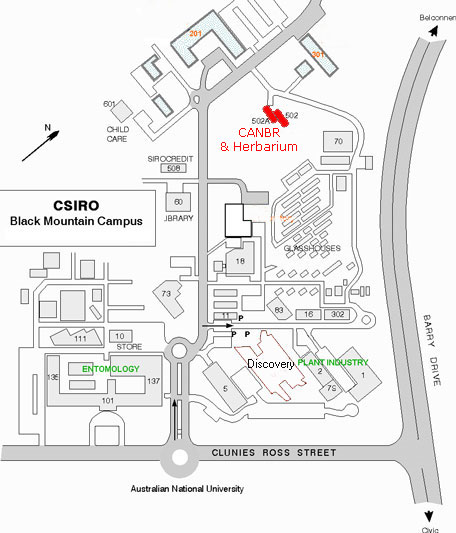
Appendix lll
Map of Australian National Botanic Gardens
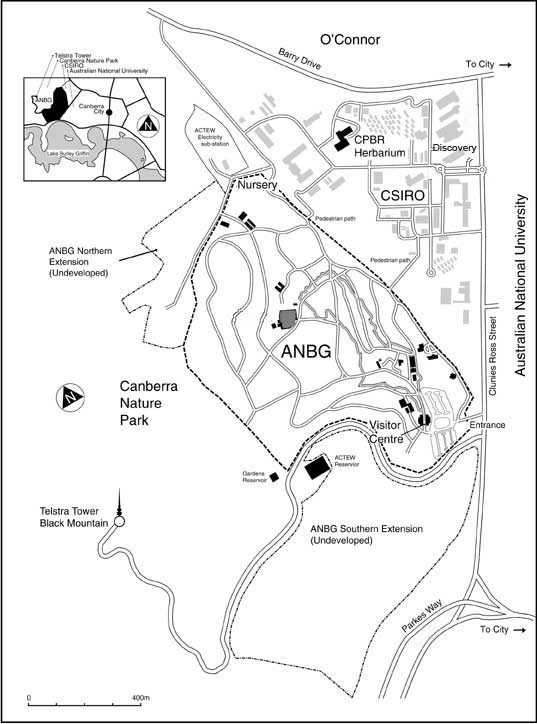
Map showing location of Herbarium on CSIRO site and the Gardens
Appendix IV
Emergency Procedures
First Aid
First Aid Officers who hold the nominated office of First Aid Attendant provide a service for emergency treatment of injuries and illness. They arrange prompt and appropriate referral to the appropriate bodies in the case of serious injury and illness.
First Aid Officers CSIRO Site
- Jo Palmer Level 3 6246 5523
- Bronwyn Collins Level 2 6246 5133
First Aid Officers ANBG Site
- Helen Thompson 6250 9445
Emergency Evacuation Procedure – Herbarium CSIRO site
- On the fire alarm sounding vacate the building immediately via the exit nearest you.
- Close any windows that you can as you go
- Wardens will close doors
- Do not use the lifts
- Move promptly to the assembly area, which is at the front of Building 502a, beyond the director’s car park. Keep off the paved area and roadway.
- Do not return to the building until you have been directed to do so by your warden.
- Do not leave the site.
- If you are mobility impaired and have difficulty vacating the building your warden will assign someone to assist you.
Fire Wardens on the Herbarium CSIRO site are:-
Building Warden (Blg 502A, Level 2) Randy Bayer 6246 5514 or 5246
Deputy Warden (Blg 502, Level 2) Andrew Slee 6246 5114 or 5534
- Level 1 Building 502 – Lee Halasz 6246 5510
- Level 1 Building 502 – Ian Warren 6246 5124
- Level 1 Building 502A – Helen Hadobas 6246 5506
- Level 2 Building 502A – Randy Bayer 6246 5514 / 5246
- Level 1/2 Building 502A – Bronwyn Collins 6246 5133
- Level 3 Building 502A – Anthony Whalen 6246 5175
- Level 3 Building 502A – Karina Richards 6246 4928
Appendix V
ANBG Fire Wardens
Chief Fire Warden- must be notified of all fires as soon as possible |
Joe McAuliffe ANBG speed dial 6667 or 0408 400 989 |
Deputy Chief Fire Warden |
Paul Janssens Craig Cosgrove |
Fire WardensAdministration Visitor Centre Botany Building (ground floor) Botany Building (1st floor) Herbarium Research Ellis Rowan Building Café Crosbie Morrison Building |
Banks Building Franklin Building Bottom Depot Top Depot Nursery Top Cottages Grounds |
Appendix VI
EMERGENCY SERVICES - GENERAL
Fire Dial 0-000
Police Dial 0-000
Ambulance Dial 0-000
Note: The above number should only be used for emergency calls for Fire, Police and Ambulance, not for any other purpose.
On Site Guards – Guard House 6246 5651
Site Wardens – Chris Rath 6246 5050, Andrew Tracey 6246 5151
Other Services - Direct Numbers
Ambulance 0-6249 8133
Fire Brigade 0-6295 5711
Police 0-6249 7444
Calvary Hospital 0-6201 6111
John James Memorial Hospital 0-6281 8100
Woden Valley Hospital 0-6244 2222
Burst Water Mains 0-6248 3433