





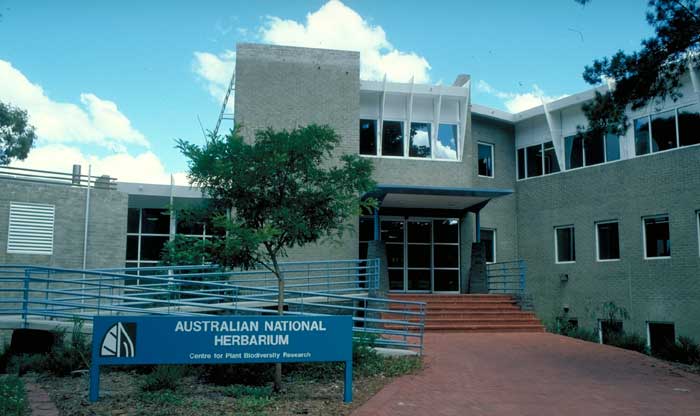
 Introduction
What is an Herbarium?
Herbaria are collections of preserved plant and fungal specimens and their associated data. They are concerned primarily with scientific research and documenting the vast diversity of plant and fungal life.
Origins of the Australian National Herbarium
The Australian National Herbarium arose from the amalgamation over the years of several herbaria managed by the Commonwealth Government. These included several CSIRO herbaria, the Forest Research Institute Eucalypt Collection, the Forest Research Institute's Atherton Rainforest Collection, and the Australian National Botanic Gardens Herbarium. The CSIRO's core collection, previously known as 'Herbarium Australiense', was renamed 'Australian National Herbarium' in 1984.
 Herbarium Specimens
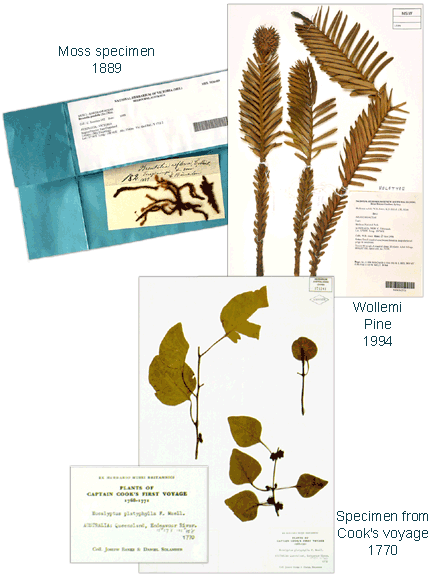
Specimens and their associated data form the core of the Herbarium. Specimens of flowering plants and ferns are usually pressed, dried, and mounted on sheets of light cardboard about 30cm x 45cm in size. Cryptogams (mosses, lichens etc) are usually stored in folded paper envelopes.
Dried specimens of plants stored in good environmental conditions will last many centuries, the Australian National Herbarium has specimens collected by Joseph Banks on Captain Cook's voyage to Australia in 1770.
Explore a typical herbarium specimen.
Specimens of flowering plants and ferns are stored flat in moveable shelving units called 'Compactus'. These are common in many herbaria around the world.
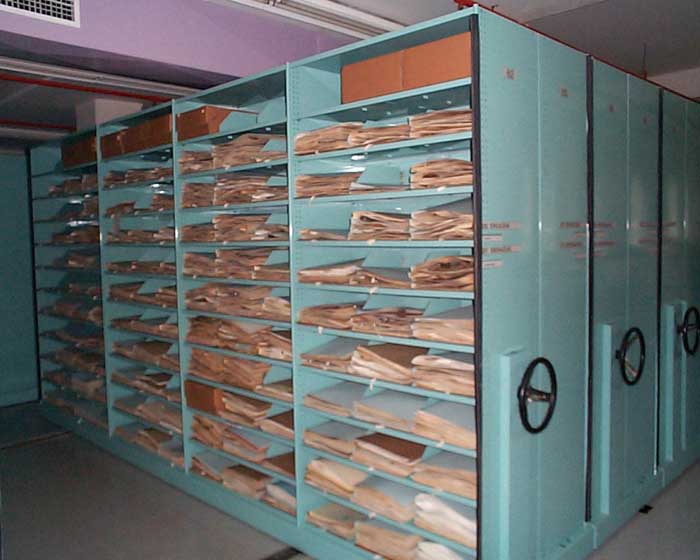 Compactus storage of specimens |
In the Australian National Herbarium, most of the mounting of specimens is undertaken by volunteers, freeing the scientific and technical staff to undertake a range of activities requiring more specialised knowledge and training.
Find out more about our Volunteer Program.
The collections are maintained in archival conditions and only materials manufactured to last for hundreds of years are now used. Older specimens, usually on inferior material, often have to be re-mounted onto archival card with long-lasting materials.
Access to the Collection
Access to the collections of the Australian National Herbarium is restricted – it is not a public facility, and access is usually only available to researchers from other institutions. Community groups, clubs and societies, or educational institutions can be given a guided tour of the facilities by arrangement. Please see Visitors page.
Public Reference Herbarium
A Public Reference Herbarium is available 5 days a week in the Botanical Resource Centre, near the Cafe at the Australian National Botanic Gardens. The specimens that you will see here are duplicates of those in the main collection. They are mounted on cardboard sheets, but smaller than the main collection and in plastic sleeves to protect them during handling. The range of species included in the Public Reference Herbarium is restricted to those of south eastern Australia.
Find out more about the Public Reference Herbarium.
The data associated with the specimens
It is the associated data that gives value to the herbarium specimen. At the time the collection is made, information is recorded about the date, locality and conditions under which the plant is growing, and who collected it.
This information, usually first entered into a field notebook and later transfered to a label attached to the specimen, provides an invaluable resource about our biodiversity. In recent years this information has been incorporated into the Herbarium's computer database, and the information from earlier collection labels is also being added to this database. This data is the core of Australia's Virtual Herbarium, a project initiated in 2001 to make the information from herbarium specimens in all Australia's major collections available on the World Wide Web.
Codes to identify the Herbarium
Each herbarium in the world has a unique identification code of two to five letters. The Australian National Herbarium in Canberra has the code CANB, while its collection of rainforest species at Atherton in north Queensland had the code QRS. Prior to the amalgamation of the collections, the code for the herbarium at the Australian National Botanic Gardens was CBG (because it had earlier been known as Canberra Botanic Gardens).
The codes for all the other major Australian herbaria can be seen on the opening page of Resources of Australian Herbaria, a web site maintained by the Council of Heads of Australian Herbaria (CHAH).
Scientific use of the collection
Herbaria throughout the world are the core research institutions for the classification and naming of plants. Scientists employed by the Centre for Plant Biodiversity Research, as well as honorary associates, visiting researchers and post-graduate students use the collection as the basis for their research. There is an active loans and exchange program to make our specimens available to researchers in other institutions and to borrow specimens from other herbaria for studies undertaken by our own scientists. A range of other research projects on the conservation and utilisation of your flora also draw heavily on the resources of the Herbarium.
Research undertaken at the Herbarium is usually published in the form of a scientific paper in a recognised scientific journal. It is in these papers that new species of plants are described and named, usually as part of a comprehensive study of a group of plants known as a 'revision'. These 'revisions', often documenting many years or research, often reveal inconsistencies and mistakes from the past, or new interpretations based on new techniques (such as DNA analysis), which result in plant name changes.
The Centre's major research projects on the classification and naming of plants are set out as Program A, while our research into the conservation and utilisation of the Australian flora is set out as Program B.
Type Specimens
One group of specimens are particularly important in an herbarium. 'Type specimens' are those nominated by a botanist describing a new plant as the bench-mark or standard for the name given to the plant. A type specimen is nominated for a species or sub-species at the time the plant is first described. There are a range of different 'types' with different names according to their status, thus a 'lectotype' is one nominated by a botanist if the original (or 'holotype') has gone missing.
The Australian National Herbarium has over 8,000 type specimens, making it a rich resource for research into the classification of plants.
Holdings of the Australian National Herbarium
The total Australian National Herbarium collection (Canberra [CANB] and Cairns [CNS]) comprises almost 1.2 million specimens, including about 8215 type specimens.
 |
Particularly comprehensive collections are held for Australasian bryophytes and lichens, Myrtaceae (especially Eucalyptus and Melaleuca-Callistemon), Orchidaceae, Sapindaceae, Lauraceae, Portulacaceae and some sections of Poaceae, Rutaceae, Proteaceae and Fabaceae.
A strong representation of New Guinean material derives from past CSIRO involvement in that area and a comprehensive specialist collection of tropical Australian rain forest species that was developed at Atherton (>100 000 collections), is now on loan to the Australian Tropical Herbarium in Cairns (CNS).
Voucher material for the ANBG Living Collections and the ANBG Photograph Collection is clearly identified and accessible; the status of associated live material at ANBG is available on-line. The existence of properly vouchered herbarium specimens for ANBG's live plants is critical for the scientific integrity and ongoing usefulness of scientific studies using those plants (e.g. for DNA extracts).
Some field work activities are directed at improving the overall representativeness of the collections, as distinct from purely research-targeted fieldwork. The two activities are however often combined to maximise the efficiency of limited time in the field.
Australian National Herbarium (June 2013)
CANB = Australian National Herbarium in Canberra
GROUP |
Total no. Specimens |
*Total no. specimens databased |
Percent databased (%) |
Total no. Types |
|
|
|
|
|
Dicots |
652,649 |
485,234 |
74.3 |
6,061 |
Monocots |
165,866 |
148,704 |
89.6 |
1,598 |
Gymnosperms |
4,327 |
4,259 |
98.4 |
30 |
Pteridophytes |
25,599 |
24,552 |
99.8 |
143 |
Mosses |
120,388 |
61,845 |
51.3 |
178 |
Hepatics |
31,253 |
23,060 |
73.7 |
98 |
Hornworts |
611 |
611 |
100.0 |
4 |
Lichens |
104,053 |
89,199 |
85.7 |
1,157 |
Fungi |
12,346 |
12,346 |
100.0 |
85 |
Slime Moulds |
226 |
226 |
100.0 |
0 |
*Algae |
7,494 |
2,026 |
27.4 |
3 |
|
|
|
|
|
TOTAL |
1,124,812 |
853,062 |
75.8 |
9,357 |
* Lucas Collection is on long term loan at NSW and is being databased by NSW, all specimens at CANB databased
Collection management Jul 2012 - Jun 2013
| Mounting - cryptogam: | 5,102 | |
| Mounting - vascular: | 18,327 | |
| Mounting - Total: | 23,429 | |
| New Accessions - v & c : | 7,608 | |
| Databasing additions: | 9,245 | |
| Total specimens databased : | 853,062 |
Specimen Loan and Exchange Services
Loans services make the Herbarium collections available to researchers at other institutions for fixed terms on specified projects and conversely allow the borrowing by our research staff of specimens from elsewhere. Such transactions are necessary to build up a comprehensive profile, from the best possible information base, of species under study.
Exchange services provide for the permanent exchange of duplicate specimens between institutions. The Australian National Herbarium maintains exchange relationships for vascular and non-vascular groups with over 200 herbaria worldwide.
Herbarium Loans & Exchange transactions 2012– 2013
Jul 2012-Jun 2013 |
No. of despatches |
No. of items |
Outloans sent |
36 |
2,337 |
Outloans returned |
31 |
2,707 |
Inloans received |
16 |
2,276 |
Inloans returned |
27 |
2,154 |
Inloans transferred |
0 |
0 |
Exchange sent |
24 |
2,600 |
Exchange received |
37 |
1,955 |
TOTAL |
171 |
14,029 |