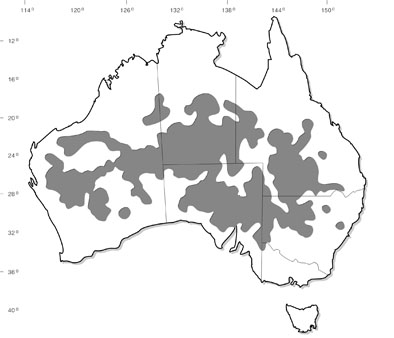
Distribution of Acacia anuera and its allies in the Mulga complex
Acacia aneura and its close relatives form a highly variable species complex commonly known as Mulga. They are small trees that dominate the vegetation of arid regions, in all occupying around 20% of Australia. This project investigates the taxonomic boundaries using both comparative morphological studies with a detailed genetic study within and among Mulga taxa and populations.
Methods:
The data will primarily be generated from newly collected specimens from all over Western Australia as well as from
previously collected material from Western and Central Australia. Morphological variability will be measured with morphometric
measures. A microsatellite library has been generated and loci are being analyzed. DNA will be extracted from specimens
and microsatellite and chloroplast DNA variation data will be generated from both within and among populations. Root tip
chromosome counts and flow cytometry methods are being generated in order to determine ploidy levels.